Online Pokies: The Honest Guide to RTP, Volatility and Real Money Play
Published 2026-07-25 · Updated 2026-07-25 · By the PlayersReports Editorial Team
Type "online pokies" into a search bar in Australia or New Zealand and you'll get millions of results in under a second, most of them either marketing copy dressed up as advice or forum folklore about "loose" machines and lucky times of day. Neither is much use to you. This guide is PlayersReports's attempt to explain how these games actually work — the real maths behind return-to-player and volatility, the bonus terms written specifically to catch slots players out, and an honest account of where Australian law actually sits — without pretending we can currently point you to a specific operator, because right now we can't.
What are pokies, exactly?
The word itself is a regional accident more than anything mathematical: it began as a nickname for club and pub gaming-room cabinets and simply followed the games onto the internet once they moved there. Search for online pokies australia and you land on the same lobbies, the same reel sets and the same random number generators that a player in London or Los Angeles would find under the plainer label "slots" — different word, identical software underneath. Provider branding follows the international convention almost everywhere, which is why a lobby menu will usually say "slots" even on a casino actively marketing itself to an AU audience.
What has changed enormously over the decades is the format. A physical pokie is a single cabinet with a fixed set of reels bolted to a gaming floor. An online pokie is software: the same studios that build land-based cabinets — and dedicated online-only developers alongside them — now produce thousands of digital titles with wildly different themes, mechanics, bonus rounds and, crucially, different RTP and volatility profiles from one title to the next. That variety is exactly why "just play a pokie" is bad advice on its own — two games with identical branding and stake sizes can play completely differently, and the two numbers that actually explain why are RTP and volatility, covered next.
How RTP actually works (a worked example)
RTP — return to player — is the single most misunderstood number in the pokies world, mostly because it gets described as a promise when it is really a long-run statistical average. Take a pokie advertised at 96% RTP. Feed it $100 in total wagers and, over a genuinely large number of spins — realistically the tens of millions the underlying maths is built on, not a single sitting at your kitchen table — the game is designed to return $96 for every $100 wagered, with the operator keeping the remaining $4 as its statistical edge (equivalently, a 4% house edge). That is the whole calculation: RTP and house edge are two sides of the same number, always summing to 100%.
The part that gets left out of most explanations is what that 96% figure does not tell you. It is not a guarantee about your Tuesday-night session, your first 100 spins, or even your first 10,000. Because RTP is a law-of-large-numbers average, small and medium sample sizes can and regularly do swing well above or well below the theoretical figure in either direction — a player can lose steadily for hours on a 97% RTP game, or walk away well ahead after twenty spins on a 92% RTP game, and neither outcome says anything meaningful about whether the advertised RTP is accurate. Each spin is also generated independently by a certified random number generator with no memory of previous spins, which is the technical reason there is no such thing as a machine being "due" a win after a cold streak, or secretly "loosened" at a particular time of day — regulated RNG software has no mechanism for either idea, and reputable studios have their RNGs independently tested and certified precisely to rule this kind of manipulation out.
Volatility: why two 96% pokies can feel completely different
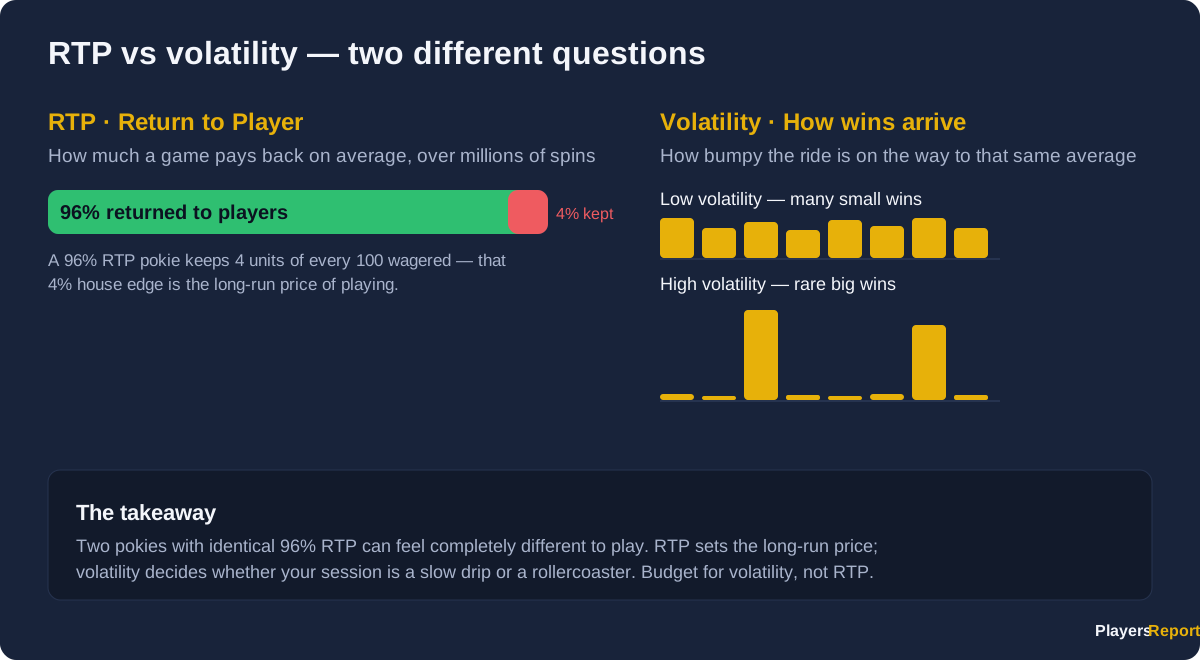
If RTP tells you roughly how much a game gives back over the long run, volatility (also called variance) tells you how it gives that money back — and it is arguably the more useful number for judging what an actual session will feel like. A low-volatility pokie tends to pay out smaller wins relatively often, smoothing a session's ups and downs so your balance moves in gentle waves rather than sharp cliffs. A high-volatility pokie tends to do the opposite: it can go through long, often frustrating stretches paying nothing worth mentioning, before a single spin lands a win worth many multiples of the stake that triggered it.
Here is the part that trips people up: both of those games can theoretically carry the exact same 96% RTP baked into their maths. RTP measures the size of the tap over a huge number of spins; volatility measures how unevenly that tap runs in the short and medium term. A studio building a low-volatility title and a studio building a high-volatility title can both target 96% and land on it over enough spins, while producing sessions that feel nothing alike. Most reputable studios label a game's volatility — usually low, medium or high — directly on its information screen, and that rating, together with the game's minimum and maximum stake, usually tells you far more about what a session will actually feel like than the RTP number does on its own. Free demo play, where an operator offers it, is a genuinely useful way to get a feel for a specific title's volatility before wagering real money pokies stakes on it.
Pokies-specific bonus traps: max-bet caps and game weighting
A welcome bonus's headline percentage and its real value once you actually try to clear it are often two very different numbers, and pokies players run into two traps more than anyone else on a casino's books. The first is the max-bet cap: most bonus terms specify a maximum stake per spin allowed while wagering requirement is still outstanding, commonly somewhere in the low single digits of the account currency, though the exact figure always sits in that specific operator's terms rather than any industry standard. Exceed that cap on even a single spin — often just once, by accident, on a game with an unusually high default stake — and many operators reserve the right to void the entire bonus and any winnings attached to it, not just the offending spin.
The second trap is game weighting. Pokies typically count 100% toward clearing a wagering requirement, which is exactly why bonus terms so often steer players toward slots in the first place — but not every pokie is treated equally even within that category. High-RTP titles, jackpot pokies and "feature buy" games that let you pay directly for a bonus round are commonly weighted lower, capped in how much they can contribute, or excluded from wagering entirely, while table games, live dealer and video poker frequently count for as little as 5-20% of their value or nothing at all. None of this is disclosed on the marketing page advertising the bonus — it lives in the full terms, and reading them before you opt in is the single most useful five minutes you can spend before chasing any welcome offer. Our published rating methodology explains exactly how we weigh a bonus's real value, after wagering, game weighting and max-bet rules, against its headline number for every casino we score.
The legal reality in Australia, carried over honestly
We are not going to tell a different story here than the one on our dedicated Australia hub, because the legal position doesn't change depending on which product page you land on. The Interactive Gambling Act 2001 makes it an offence for a gambling company to offer online casino games — pokies included — to anyone physically located in Australia, regardless of where that company holds a licence, with civil penalties running up to A$1.8 million per day for a corporation and up to A$360,000 per day for an individual involved in the breach. The Australian Communications and Media Authority (ACMA) enforces that law by blocking offending domains at the ISP level, and has blocked more than 1,700 gambling sites to date.
Here's the detail most casual guides get wrong: none of the above criminalises you for actually spinning the reels. Parliament wrote the 2001 Act to police the business side of the transaction, and Australia's enforcement record to date has no case of a player being prosecuted purely for holding an account at an offshore site. Grey market is our deliberate word choice over either "legal" or "banned" for exactly this reason — but grey cuts both ways. Play carries essentially no legal risk for you personally, while at the same time nobody with statutory power stands behind you if a withdrawal gets stuck, because a company with no Australian licence answers to no Australian regulator. Read that as neither a green light nor a warning siren; it's simply the mechanics of how this particular law is built.
How we review a slots-heavy casino
Every casino we cover is scored against the same published rating methodology — trust and licensing, payout speed, games, bonuses and support — but a slots-heavy operator gets a few extra, pokies-specific questions layered on top. We look at whether a casino publishes RTP figures for its titles or at minimum offers free demo play so a player can judge volatility before wagering; whether its lobby is built on established, independently audited studios — names such as Pragmatic Play, Play'n GO, NetEnt, Red Tiger and Hacksaw Gaming turn up across most reputable lobbies — rather than obscure, unbranded titles of uncertain RNG certification; and whether its bonus terms disclose max-bet caps and game-weighting rules plainly, rather than burying them in a wall of text designed to be skipped.
A casino loses points in our scoring for a thin or padded slots catalogue, undisclosed or unverifiable RTPs, and bonus terms that make max-bet or weighting rules unusually easy to breach by accident. None of that changes because a player happens to be searching using AU or NZ vocabulary rather than "slots" — the underlying game and the underlying scrutiny are the same.
The honest answer: no reviewed casino currently serves Australia
Plenty of pages built around a keyword this valuable would slot in a "top pick" here regardless of the facts. Ours won't, because the facts don't support one: scanning our entire published review set turns up zero casinos that currently list Australia as an accepted market. There's no "play now" button on this page, no shortlist dressed up to look ranked, and no affiliate link hiding anywhere in this section — putting one here would mean vouching for a brand we haven't actually confirmed treats Australian players well, and a quiet nudge toward an unverified operator does more harm than simply saying we don't have one.
Getting a casino added to this page in future takes proof, not merely the lack of a block screen: a stated, current willingness to take Australian sign-ups, a licence we can trace back to a real regulator, functioning AUD deposit and withdrawal rails, and a track record — built on more than the operator's own marketing copy — of actually paying Australian-facing players. Short of clearing that bar, this section stays empty on purpose. Got an unresolved dispute with a casino you found somewhere else entirely? Our complaints hub logs it and puts the operator through a right-of-reply process before publishing anything. And if the fun has gone out of playing altogether, our responsible gambling page carries zero affiliate links, deliberately.
Pokies across the region: Australia, New Zealand and beyond
Australia's legal settings around online pokies have sat still for two decades, with no comparable licensing overhaul currently working its way through federal law. New Zealand's story is different: its New Zealand hub covers the Online Casino Gambling Act 2026, a licensing regime moving through expressions of interest and auction stages toward a targeted launch through late 2026 and into 2027 — a contrast worth watching if you're curious whether Australia's own approach might eventually shift in the same direction. Until either market changes in a way that lets us recommend a specific, verified operator, this page and our Australia hub will keep saying so plainly rather than quietly moving on.
The bottom line: understanding RTP, volatility and the bonus terms written specifically around slots play will serve you regardless of which operator you eventually use, which is why we've built this page to stand on its own rather than as a wrapper around a casino list. We update it as the legal and operator landscape moves — check the date above, and the two linked hubs, for whatever has changed since.
Frequently Asked Questions
What does "pokies" actually mean?
"Pokies" started life as Australian pub-and-club shorthand for poker machines, and the nickname has since carried over to their online descendants, even though the word has no real connection to playing cards. New South Wales clubs legalised the machines in the 1950s, the name stuck across Australia and New Zealand, and today it sits alongside "slots" as two labels for one product — international software studios brand their games as slots in the lobby, even though most AU and NZ players would happily call that identical game a pokie in everyday conversation.
How does RTP actually work on an online pokie?
RTP (return to player) is a theoretical long-run average built into a game's maths, not a promise about any single session. A 96% RTP pokie is designed to return $96 for every $100 wagered across the tens of millions of spins that average is calculated over — over 100 or even 1,000 spins, your actual results can swing well above or well below that figure in either direction, because the average only stabilises once the sample size becomes genuinely enormous.
Does a higher RTP always mean a "better" pokie to play?
Not necessarily, because RTP says nothing about volatility — how a game distributes its wins. A 94% RTP low-volatility pokie can feel far more generous session to session than a 97% RTP high-volatility one, since the low-volatility game pays smaller amounts more often while the high-volatility game pays rarely but bigger. RTP and volatility are two separate numbers, and ignoring the second one is a common way players misjudge how a game will actually play.
Can a casino make a machine run "hot" or "cold", or is a slot ever "due" for a win?
No. Every spin on a properly regulated online pokie is generated independently by a certified random number generator with no memory of previous spins, so there is no mechanical or software concept of a machine being "due" a win after a losing streak, or "loose" versus "tight" at a given time of day. That idea is a carryover from land-based gaming-floor folklore and has no basis in how certified RNG software is built or audited.
Is it illegal for me personally to play pokies online in Australia?
No. Federal law targets the operator that offers pokies to you, not you for accepting the offer, and Australia's enforcement history contains no instance of a player facing charges for using an offshore site. It's that operator-versus-player split that leads us to call this a grey market rather than something flatly legal or flatly banned. Our Australia hub, linked below, walks through the full legal mechanics in depth.
Which online casino does PlayersReports recommend for real money pokies in Australia?
None, currently. Scanning every casino in our published lineup, not a single one currently accepts Australian sign-ups, and we won't point you toward a brand we haven't actually confirmed treats this market fairly. We'd rather this answer stay a plain 'none yet' than pad it with a casino picked just to have something to show you — it updates the moment that changes.