Wagering Requirement Calculator: How Much You Must Actually Bet
Published 2026-07-30 · Updated 2026-07-30 · By the PlayersReports Editorial Team
A bonus's headline percentage tells you almost nothing about how much work is actually required to withdraw it — the wagering (or "rollover") requirement is the number that does that. Our wagering requirement calculator below turns a bonus amount and a multiplier into the real total turnover required, and this page walks through the same honest maths our editorial team uses to weigh bonus fairness across every casino we review.
Wagering requirement calculator
Work out the total turnover a bonus's wagering requirement actually demands.
Total turnover required: —
Qualifying bets/spins needed: —
Expected loss clearing that turnover: —
The formula behind the number
Turnover required equals the relevant amount multiplied by the wagering multiplier: (bonus, or bonus plus deposit) × multiplier. A $500 bonus at a 28x requirement, wagered on the bonus alone, needs $500 × 28 = $14,000 in total qualifying stakes before a withdrawal unlocks. If that same operator instead wagers bonus plus deposit combined — say a $500 deposit matched by a $500 bonus at 35x — the calculation becomes ($500 + $500) × 35 = $35,000. Same-looking bonus, wildly different real requirement, purely because of which amount the multiplier is actually applied to. That single distinction is buried in the fine print on almost every operator's terms page, never in the marketing headline, which is exactly why our calculator makes it an explicit toggle rather than a hidden assumption.
Turnover counts every qualifying bet you place, win or lose — it is not your net position. Betting $100 and losing it, then betting the same $100 again after a top-up and winning, still counts as $200 of turnover even though your balance never grew, which is the single most misunderstood detail about how wagering requirements actually work. This is also why average stake size matters so much to how quickly a requirement clears: smaller, more frequent stakes rack up turnover just as effectively as fewer, larger ones, for a given total amount wagered.
Worked examples from real casino bonus terms
These figures come directly from our own published reviews, not hypothetical round numbers. Our W88 review records a 15x wagering requirement on its flagship Club W casino welcome bonus, one of the lower multipliers among the operators we cover — plug your own bonus amount into the calculator at 15x to see how comparatively little turnover that specific offer demands next to the examples below. Our 1xbet review notes a considerably steeper 35x requirement on the bonus amount, applying only to eligible slots and its in-house 1xGames within seven days of crediting, with live dealer tables, roulette, blackjack, baccarat, poker and bingo all excluded from clearing it entirely — meaning every dollar wagered on an excluded game does nothing to unlock the bonus, no matter how much of it you play.
Our Dafabet review lists a 20x requirement on its casino welcome bonus, with separate sportsbook tiers carrying either 15x or 40x on deposit-plus-bonus combined depending which tier a player selects — a good illustration of how one operator can run genuinely different wagering economics side by side across its own products. The starkest example in our published reviews is BK8's headline 288% welcome bonus up to MYR 2,880, wagered at 35x on slots: run the maximum bonus amount through the calculator above and the total turnover required comes out at MYR 100,800 — a genuinely eye-opening figure next to the MYR 2,880 the bonus itself is worth, and exactly the kind of gap between headline and reality our rating methodology is built to weigh.
The expected-loss reality underneath the turnover figure
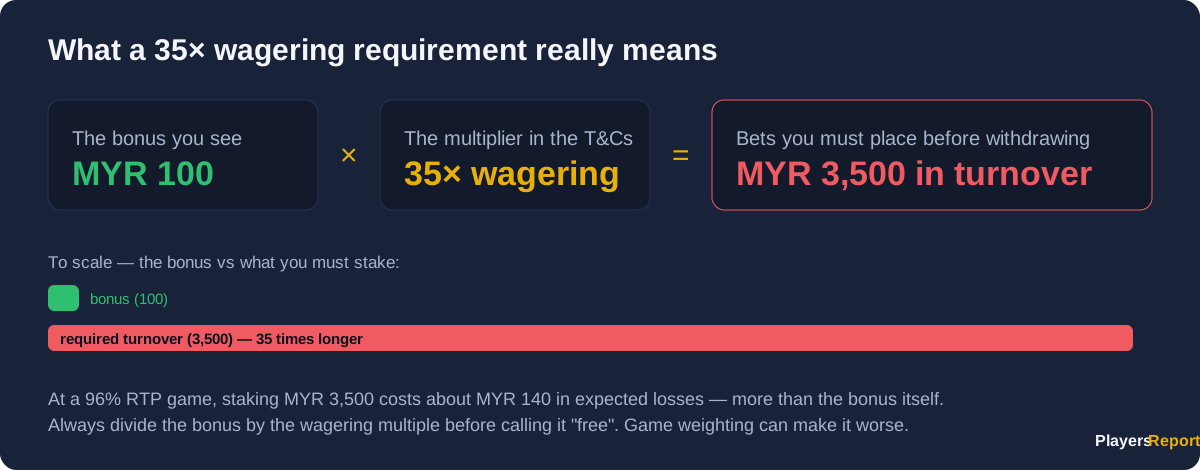
Turnover is not free to generate — every qualifying bet is played at whatever house edge that game carries, meaning clearing a large wagering requirement has a statistical cost baked in before you ever decide whether to withdraw. At a typical online slot RTP of around 96%, wagering through MYR 3,500 in stakes carries an expected loss of roughly MYR 3,500 × (1 − 0.96) = MYR 140 from house edge alone, on average, regardless of how any individual session actually plays out. Scale that up to the BK8 example above — MYR 100,800 in required turnover at the same 96% assumption — and the expected loss from house edge alone reaches roughly MYR 4,032, entirely separate from whether you end up winning or losing your actual bonus-funded bets along the way. Our calculator above includes this same expected-loss estimate once you enter an assumed RTP, precisely so this reality sits next to the turnover number rather than hidden behind it.
None of this means clearing a wagering requirement is unwinnable — plenty of players clear bonuses and withdraw a genuine profit, because RTP is a long-run average, not a guaranteed outcome on any specific set of spins. It does mean the honest, statistically expected outcome of wagering a large amount of turnover leans toward a loss roughly proportional to the house edge, which is the same framing our rating methodology uses when scoring how fairly a casino's bonus terms actually treat players, rather than judging bonuses on their headline percentage alone.
Where the headline number misleads you
A wagering multiplier on its own, stripped of the amount it applies to, the game-weighting rules and the expiry window, tells you far less than it appears to. Two operators offering "35x wagering" can demand wildly different real turnover once one applies it to the bonus alone and the other to bonus plus deposit combined, and can present wildly different real difficulty once one weights slots at 100% with a generous 30-day window and the other caps max-bet aggressively with a seven-day deadline. The multiplier is a necessary number for this calculation, but it is never the whole picture — always read the full bonus terms for the amount it applies to, which games count, any max-bet cap, and the expiry window, alongside whatever this calculator tells you about raw turnover.
The bottom line: a bonus's real value lives in its wagering requirement far more than its headline percentage, and the turnover figure — plus the expected loss sitting quietly underneath it — is the honest number worth calculating before you opt in, not after you've already started wagering toward it.
Frequently Asked Questions
What does a "35x wagering requirement" actually mean in practice?
It means you must place bets totalling 35 times the relevant amount — usually the bonus alone, sometimes the bonus plus your deposit — before you can withdraw. A $100 bonus at 35x needs $3,500 in total qualifying stakes before withdrawal unlocks, regardless of whether your balance goes up or down along the way. Turnover counts every qualifying bet you place, not just your net win or loss, which is the detail most players miss when a headline bonus percentage looks generous.
Does it matter whether wagering applies to the bonus only or to bonus plus deposit?
Enormously. A $500 deposit matched by a $500 bonus at 35x wagering the bonus alone requires $17,500 in turnover. The same numbers at 35x wagering bonus plus deposit combined require $35,000 — exactly double. This single distinction, buried in the small print rather than the marketing headline, can double the real work behind an identical-looking bonus percentage and multiplier, which is exactly why our calculator lets you toggle it on or off.
Why do some games count 100% toward wagering while others count far less or nothing?
Operators weight games by how much house edge they carry and how quickly they can be played, because a low-edge, fast-play game clears turnover cheaply for the player and expensively for the operator. Slots typically count 100% since they carry a normal house edge; blackjack, baccarat and other low-edge table or live games are commonly weighted down to 10-20% or excluded entirely, since a skilled player grinding low-edge games could otherwise clear a bonus at very little real cost.
Is a lower wagering requirement always a better deal than a higher one?
Usually, but not automatically — the multiplier is only one part of the real picture. A 15x requirement on a bonus with a very short seven-day expiry window, a low max-bet cap and heavy game-weighting restrictions can be harder to clear in practice than a 25x requirement with a 30-day window and few restrictions. Read the whole term, not just the headline multiplier, before judging which of two offers is genuinely more generous.